Custom Two-Piece Box Sets: Lid & Base Configuration Guide
Full telescope, partial telescope, or shoulder style? Learn how lid and base boxes work, how friction fit is engineered, and which style suits your product.
A two-piece box is a package made of two fully detached components: a base that holds the product and a separate lid that slides down over it. Because the lid wraps around the base's walls instead of folding from a single sheet, the finished box has double-wall strength on every side it covers, resists crushing and flexing, and closes with a clean, satisfying friction fit. That same construction creates a slow, deliberate lift-off reveal, which is why this classic format remains the go-to choice for smartphones, jewelry, luxury apparel, and board games.
This guide breaks down how lid and base configurations work, the structural styles you can choose from, how friction fit is engineered, and which materials and design details suit different products.
What Makes a Two-Piece Box Different?
Most packaging styles are made from a single die-cut blank that folds into shape: think tuck-end cartons, mailer boxes, or auto-lock bottoms. A two-piece box is different in three important ways:
- Two independent parts. The lid and base are manufactured separately and only come together at the packing stage.
- Overlapping walls. Wherever the lid covers the base, you have two layers of board working together, which significantly improves stacking and side-wall strength.
- No hinges or flaps. There are no fold lines to crease, tear, or wear out after repeated opening, so the box keeps its shape through years of reuse.
That last point matters more than many brands realize. Two-piece boxes are frequently kept rather than discarded. Customers repurpose them for storage, and every time the box is reopened, your brand is back in front of them.
The Anatomy of a Lid and Base Box
Before comparing styles, it helps to know the terminology packaging engineers use:
- Base (or tray): The bottom component that holds the product, usually with an insert.
- Lid (or cover): The top component that telescopes over the base.
- Lid depth: The height of the lid's side walls. This single measurement defines most of the style variations below.
- Neck (or collar): An inner wall that rises above the base's outer walls in shoulder-style boxes.
- Shoulder: The ledge created where the neck meets the outer base, on which the lid rests.
- Turn-in: On wrapped rigid boxes, the portion of the printed wrap paper that folds over the top edge and down the inside wall.
- Thumb notch (half-moon cut): A semicircular cutout on the base or lid wall that gives fingers a place to grip.
Structural Styles: Choosing Your Lid Depth
The biggest decision in any two-piece project is how far the lid comes down over the base. Each option changes the look, the level of protection, and the way the box opens.
Full Telescope Boxes
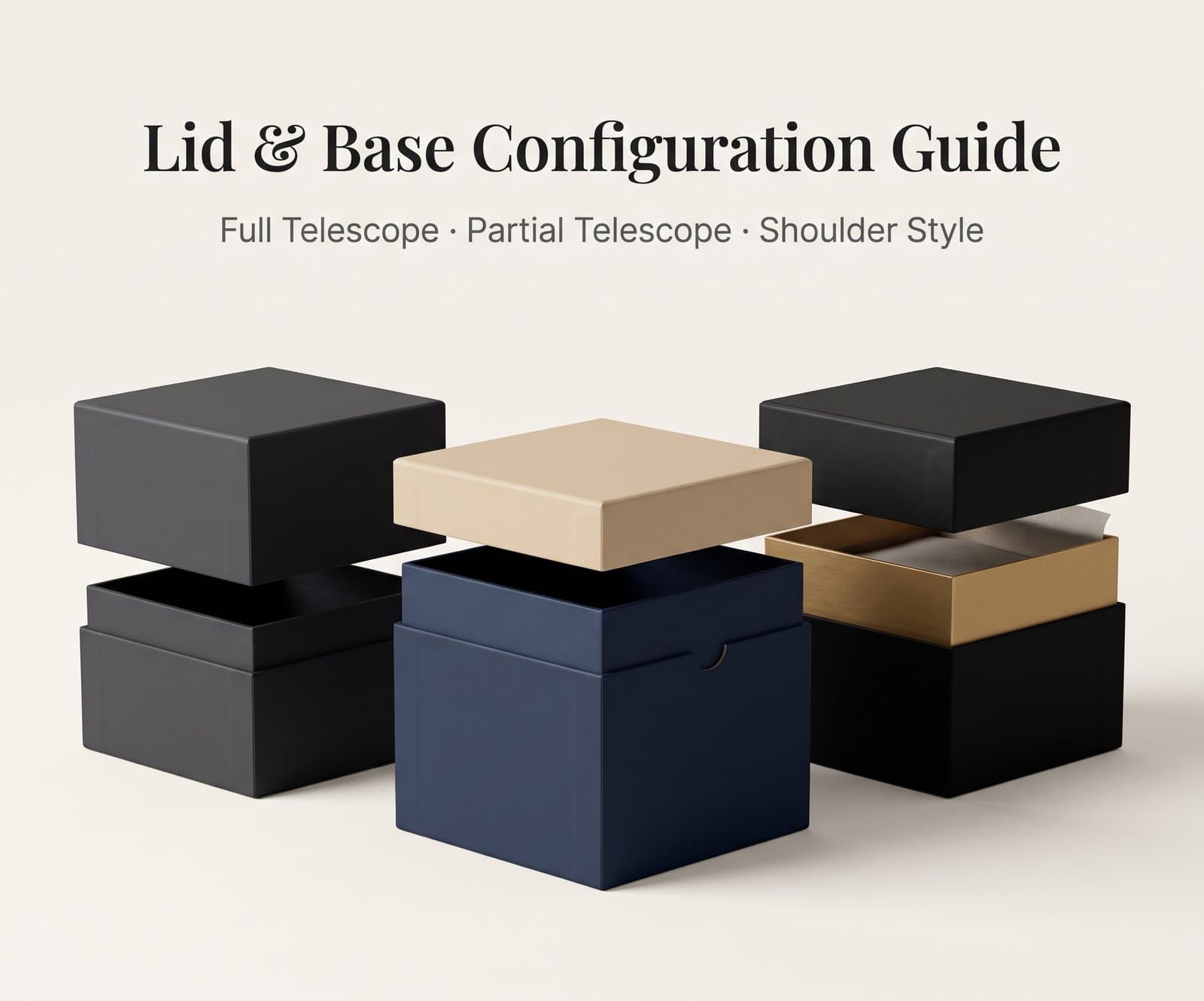
In a full telescope configuration, the lid's walls extend the entire height of the base (or very nearly so). When closed, the base is completely hidden, and you effectively have double walls on all four sides from top to bottom.
Best for:
- Heavy or fragile items that need maximum crush and stacking resistance
- Products shipped or stored in stacks, such as board games, puzzle sets, and archival storage
- Boxes that will be handled and reopened frequently
Pros:
- Maximum structural integrity and side-wall strength
- Excellent dust protection since the seam sits at the very bottom
- A single, uninterrupted print surface on the exterior
Cons:
- Uses more board, increasing material cost and weight
- Can be harder to open. With tight tolerances, customers sometimes need to hold the lid and let the base slide out, which is where thumb notches or finger holes become essential
- The base is almost never seen, so any printing on it is wasted unless the interior is decorated
Partial Telescope Boxes
In a partial telescope configuration, the lid covers only part of the base's height, typically somewhere between a quarter and two-thirds. A visible band of the base remains exposed when the box is closed.
Best for:
- Luxury apparel, shoes, and accessory boxes
- Gift sets where a contrasting base color becomes part of the design
- Products where easy opening matters more than maximum stacking strength
Pros:
- Easier to open; there is less wall contact and friction to overcome
- Uses less material than a full telescope lid
- Creates a two-tone design opportunity (for example, a black lid over a metallic or colored base)
Cons:
- Double-wall strength only exists where the lid overlaps
- The exposed seam lets in slightly more dust than a full telescope design
- Very shallow lids can shift or pop off during transit if the fit is loose
Shoulder Boxes (Neck and Shoulder Configuration)
A shoulder box is often considered the most premium two-piece configuration. The base is built as two parts: an outer base and an inner neck (or collar) that rises above it. The lid slides over the neck and comes to rest on the shoulder, so when the box is closed, the lid's outer walls sit perfectly flush with the outer base.
Many brands call this a three-piece box, since it consists of a lid, base, and neck, but it functions as a lid and base set.
Best for:
- Fragrance, high-end cosmetics, and spirits
- Premium electronics and presentation cases
- Jewelry and watches where a seamless, monolithic look is the goal
Pros:
- A clean, flush exterior with a crisp horizontal line where lid meets base
- The visible neck can carry a contrasting color, foil, or pattern revealed only on opening
- The lid can never be pushed down too far, which protects the product beneath
Cons:
- More complex to manufacture, with an extra component and tighter tolerances
- Higher unit cost than a standard telescope box
- The neck consumes a few millimeters of internal space on each side, which must be accounted for in insert design
Lid Depth at a Glance
| Style | Lid Coverage | Strength | Ease of Opening | Visual Effect |
|---|---|---|---|---|
| Full telescope | Entire base height | Highest | Hardest (needs notches) | Solid, seamless block |
| Partial telescope | Portion of base height | Moderate | Easy | Two-tone, visible base band |
| Shoulder/neck | Down to the shoulder | High | Controlled, smooth | Flush, luxury finish |
Friction Fit Engineering: The Science Behind the Perfect Lid
A two-piece box has no locks, tabs, or magnets by default. Everything depends on friction fit: the controlled contact between the inside of the lid and the outside of the base. Get it right, and the box closes with a quiet, confident glide. Get it wrong, and the lid either rattles loose or refuses to budge.
Understanding Tolerances
Tolerance is the planned gap between the lid's internal dimensions and the base's external dimensions. The lid must be slightly larger than the base to slide over it. How much larger depends on:
- Board thickness. Thicker rigid chipboard requires more allowance than thin folding paperboard.
- Wrap material. Textured papers, fabric, leatherette, and soft-touch laminations add bulk and friction.
- Desired feel. A snug, slow-closing lid needs a tighter tolerance than a lid meant to lift off easily.
In practice, tolerances for rigid boxes are usually measured in fractions of a millimeter to a couple of millimeters. Even small variations in board caliper or wrap thickness can change the feel noticeably, which is why physical prototypes are essential before a full production run. Never approve lid fit from a dieline alone.
The Vacuum (Suction) Effect
When a lid fits very precisely around a base, air becomes trapped inside as the lid is lowered. That trapped air acts as a cushion, forcing the lid (or the base, when lifted) to descend slowly. This is the vacuum or suction effect, and premium smartphone boxes are the most famous example: lift the lid, and the base glides away at its own pace.
Used intentionally, this effect is a powerful piece of unboxing theater. Used accidentally, it frustrates customers who can't get the box open. You can control it by:
- Loosening tolerances slightly if the effect is unwanted
- Adding thumb notches or finger holes that break the air seal and give leverage
- Including a ribbon pull or lift tab under the insert
- Adding small vent holes in the base floor, hidden beneath the insert
Thumb Notches and Half-Moon Cuts
A thumb notch (also called a half-moon cut or finger notch) is a small semicircular cutout in the wall of the base or lid. It serves two purposes: it gives the user something to grip, and it breaks the air seal that causes suction. Thumb notches are especially important on:
- Full telescope boxes, where there is no exposed base to hold
- Tight-fitting rigid boxes with heavy wraps
- Boxes containing products that need to be lifted from a snug insert, such as a watch or a bottle
Placing notches on opposing sides (both long walls, for example) lets users open the box with one hand on each side, which feels far more natural than a single notch.
Materials: Rigid Chipboard vs. Folding Paperboard
Two-piece boxes can be built from very different board types. The right choice depends on your product weight, budget, shipping method, and brand positioning.
Rigid Chipboard (Set-Up Boxes)
Rigid boxes are made from thick, dense chipboard (commonly in the range of roughly 1.5 to 3 mm) that is cut, formed, and then wrapped in printed paper, specialty stock, fabric, or leatherette. The box is shipped fully assembled and does not fold flat.
Choose rigid chipboard when:
- The product is high value or high weight
- The box is expected to be kept and reused
- You want premium finishes such as foil stamping, embossing, debossing, spot UV, or soft-touch lamination
- You need the controlled suction effect described above, which relies on stiff, precisely formed walls
Trade-offs: Higher unit cost, higher freight and warehouse volume since the boxes can't be shipped flat, and longer production lead times due to hand or semi-automated wrapping.
Folding Paperboard
Folding paperboard two-piece boxes are die-cut from lighter board (such as SBS or coated recycled board) and either glued or locked into shape. Some designs ship flat and are assembled at the packing stage.
Choose folding paperboard when:
- The product is lightweight (cosmetics, small accessories, confectionery)
- Budget and storage efficiency matter
- You are packaging large volumes, such as seasonal gift sets or retail promotions
Trade-offs: Less crush resistance, a less substantial feel in the hand, and a looser, less consistent friction fit compared with rigid construction.
Corrugated Two-Piece Boxes
For larger or heavier items like apparel bundles, home goods, or subscription kits, corrugated board (often E-flute or F-flute for a finer print surface) offers a middle ground. It provides real shipping strength while still delivering the lift-off reveal of a lid and base format.
Real-World Use Cases: Matching Configuration to Product
Smartphones and Consumer Electronics
Electronics brands overwhelmingly favor rigid full or near-full telescope boxes with extremely tight tolerances. The slow, suction-controlled reveal signals precision engineering, the very quality the product itself promises. A molded pulp or paperboard insert keeps the device centered, while hidden compartments beneath hold cables and documentation.
Board Games and Puzzles
Board games use wrapped chipboard full telescope boxes almost universally. The double walls survive years of shelf stacking, and the full-coverage lid provides a large, uninterrupted canvas for artwork. Thumb notches (or a slightly looser fit) are important here because players open these boxes again and again.
Luxury Apparel and Footwear
Apparel boxes are typically larger and flatter, so a partial telescope lid works well: it is easy to open, uses less board across a large footprint, and allows a contrasting base color. Tissue wrap and a branded sticker seal add to the reveal.
Jewelry and Watches
Small, high-value items call for rigid shoulder boxes or tight telescope boxes with foam, velvet, or molded inserts. The flush exterior of a shoulder box feels like a keepsake in its own right, and the neck gives designers a hidden surface for a metallic or colored accent.
Cosmetics and Fragrance
Prestige beauty brands often choose shoulder boxes for fragrance and skincare sets, while mass-market gift sets use folding paperboard telescope boxes with die-cut inserts to hold multiple items securely.
Actionable Design Tips for Lid and Base Boxes
- Design the insert first. Measure the product, then the insert, then the box. Working in the opposite direction almost always leads to rattling or overly snug fits.
- Prototype the fit physically. Order a blank or printed sample and open it dozens of times. Test it with the wrap and lamination you actually plan to use.
- Decide on the opening experience early. Do you want a slow, dramatic reveal or an easy everyday lift? This determines tolerance, notches, and material.
- Print where people will look. On a full telescope box, the base exterior is rarely seen; invest instead in the lid top, lid sides, and base interior.
- Use the inside of the lid. A printed message, pattern, or brand story on the underside of the lid is a low-cost way to surprise customers.
- Mind the turn-ins. On wrapped rigid boxes, the turn-in is visible on every edge. Specify its depth and color so it looks intentional rather than accidental.
- Consider the retail shelf. If the box will stand vertically in-store, make sure the lid is snug enough not to slide off, or add a sleeve or belly band.
- Plan for reuse. Durable wraps and scuff-resistant laminations extend the box's second life as storage, which extends your brand's visibility.
Frequently Asked Questions
What is the difference between a two-piece box and a three-piece box?
A standard two-piece box has a lid and a base. A three-piece box usually refers to a shoulder box, which adds a separate neck or collar inside the base so the lid sits flush with the outer walls.
Why is my two-piece box lid so hard to remove?
This is typically caused by tight tolerances combined with the vacuum effect. Adding thumb notches, slightly increasing the lid's internal dimensions, or adding a ribbon pull will make it easier to open.
Which lid depth is strongest?
Full telescope lids offer the most strength because the double-wall overlap runs the full height of the box.
Can two-piece boxes ship flat?
Rigid chipboard versions cannot. Some folding paperboard and corrugated designs can ship flat and be assembled at packing, which reduces freight and storage costs.
Conclusion: Building the Right Lid and Base Configuration
Two-piece boxes endure because they do two things exceptionally well: they protect with double-wall strength, and they deliver a deliberate, memorable reveal. The right configuration comes down to a few key decisions: a full telescope lid for maximum strength, a partial telescope for easy access and two-tone design, or a shoulder style for a flush, luxury finish, paired with the right material and a carefully tested friction fit.
If you've mapped out your product dimensions and preferred opening experience, a good next step is to explore two-piece box styles, sizes, and finishing options to see how these configurations translate into production-ready packaging for your brand.