Sleeve Box Packaging Guide: Design, Benefits & Uses
How sleeve boxes work, paperboard vs. rigid options, design tips, and the best retail uses—from cosmetics to jewelry. A practical guide for brands.
Custom Sleeve Boxes for Retail Packaging: Design, Benefits & Applications
A sleeve box is a two-piece package made of an inner tray (or drawer) that slides out of an outer sleeve, much like a matchbox. The tray holds and protects the product, while the sleeve carries most of the branding. Its main retail advantage is simple: the slide-out motion turns opening the box into a moment of reveal, giving shoppers a premium, gift-like unboxing experience that a standard tuck-end carton can't replicate—while still offering a large, clean printable surface for shelf impact.
Below, we break down how the mechanism works, which materials suit which products, the finishing touches that matter, and when this style is (and isn't) the right choice.
How Does a Sleeve Box Work? The Tray-and-Sleeve Mechanism Explained
At its core, sleeve packaging relies on two components working together:
- The tray (drawer): An open-top, four-walled base that holds the product. It can be a simple folded tray or a rigid, wrapped tray with inserts.
- The sleeve (slipcase): An open-ended tube that wraps around the tray on four sides, leaving the two short ends exposed so the tray can slide in and out.
Friction Fit: The Detail That Makes or Breaks the Experience
The relationship between the tray and sleeve is governed by friction fit—the tolerance between the tray's outer dimensions and the sleeve's inner dimensions.
- Too tight: The tray sticks, the sleeve scuffs, and customers struggle (or tear the box) to open it.
- Too loose: The tray slides out on its own in transit or on the shelf—a real problem for retail displays and shipping.
- Just right: A smooth, controlled glide with slight resistance that feels deliberate and premium.
Experienced packaging engineers typically allow a small clearance (often around 1–2 mm per side, depending on board caliper) and account for the thickness of any wrap paper or lamination, which adds bulk. Always request a physical sample before a full production run—friction fit is something you need to feel, not just see on a dieline.
Full Sleeves vs. Partial Sleeves (Belly Bands)
Not every sleeve covers the tray entirely:
- Full sleeve: Encloses the tray on four sides for a clean, closed package.
- Partial sleeve / belly band: A narrower band wrapped around the middle, often used over a tray or a lidded box to add branding or seasonal messaging at low cost.
Materials: Folding Carton Paperboard vs. Rigid Chipboard
Material choice affects cost, perceived value, protection, and shipping weight. Here's how the two main construction types compare.
Folding Carton Paperboard Sleeves
Made from SBS (solid bleached sulfate), CCNB, or kraft paperboard (commonly in the 14pt–24pt range), these sleeves and trays are die-cut, printed, and folded.
Best for: Mid-range cosmetics, candles, soaps, tea, confectionery, and subscription-box items.
Pros:
- Cost-effective at scale
- Ships flat, saving storage and freight costs
- Excellent print surface for full-color designs
- Lightweight
Cons:
- Less crush resistance
- Lower perceived value than rigid options
- Can flex or bow if dimensions are large
Rigid Chipboard Trays (Set-Up Boxes)
Rigid trays are built from thick chipboard/greyboard (often 1.5–3 mm) wrapped in printed paper, specialty paper, or textured stock. They're assembled at the factory and do not fold flat.
Best for: Jewelry, fragrances, luxury tech accessories, premium chocolates, watches, and high-end gift sets.
Pros:
- Premium weight and "heft" that signals quality
- Superior protection for fragile or high-value items
- Highly reusable—customers often keep them as keepsake storage
Cons:
- Higher unit cost
- Ships assembled, increasing warehousing and freight volume
- Longer production lead times
The Hybrid Approach
A very common (and smart) configuration is a rigid chipboard tray paired with a paperboard sleeve. You get the protection and luxury feel of a rigid base with the print flexibility and lower cost of a folding-carton sleeve—and the sleeve can be swapped for seasonal or limited-edition designs without retooling the tray.
FeaturePaperboard Sleeve + TrayRigid Tray + Paperboard SleeveFully RigidPerceived valueModerateHighHighestUnit costLowMediumHighShips flatYesPartially (sleeve only)NoProtectionModerateHighHighDesign flexibilityHighHighModerate
Key Design Features and Customizations
The details below separate an ordinary sliding box from one that feels intentionally designed.
Thumb Cuts and Notches
A thumb cut (or thumb notch) is a semicircular die-cut on the sleeve's open edge, or on the tray's front wall, that gives fingers something to push against.
- Makes opening intuitive—customers instantly understand how the box works
- Essential for tight friction fits
- Can be shaped (half-moon, oval, or custom brand shapes) as a subtle design element
Ribbon Pulls
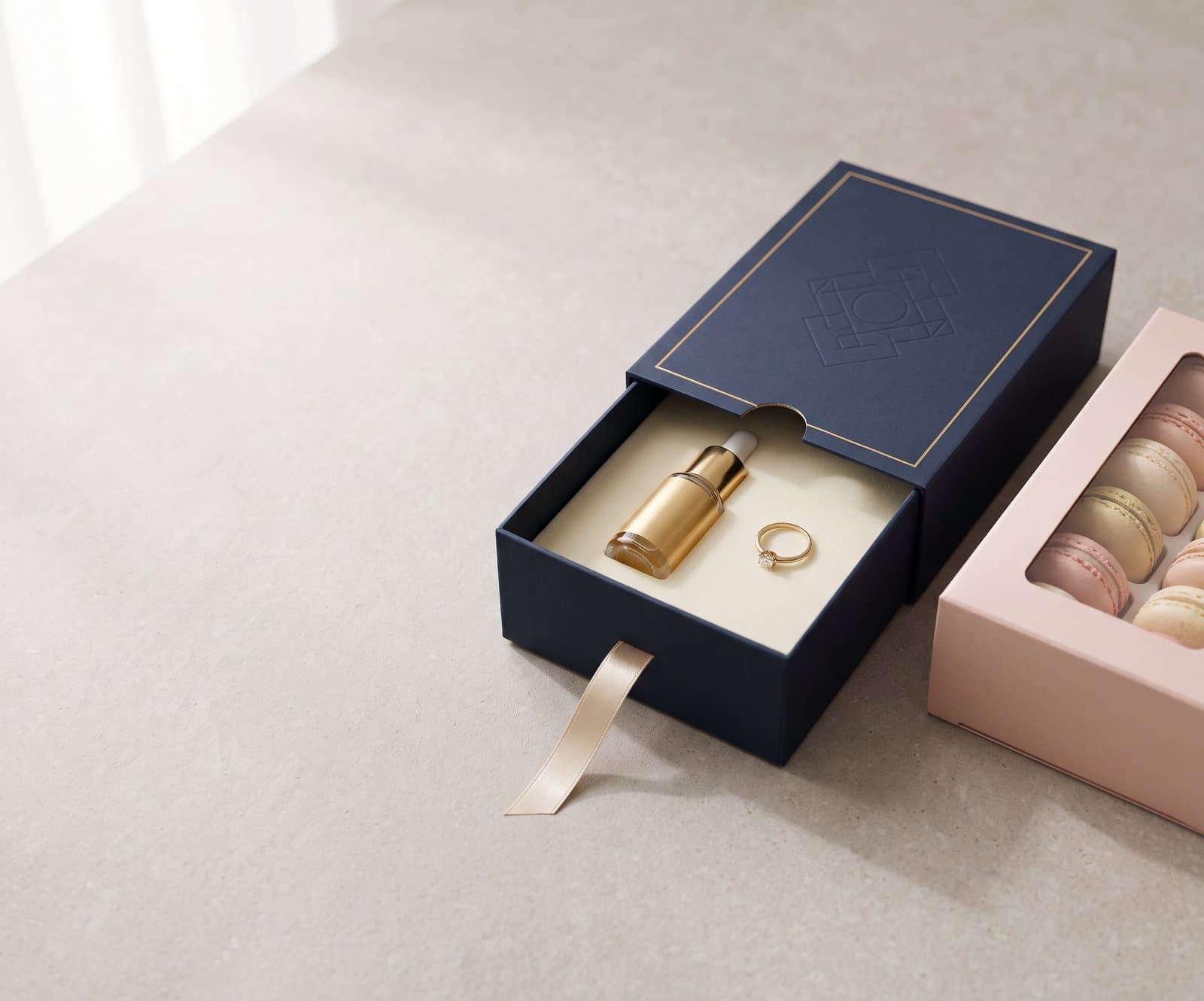
A ribbon pull is a short loop of satin, grosgrain, or cotton ribbon attached to the tray's end wall. Pulling it draws the drawer out smoothly.
- Adds an unmistakable luxury cue, especially for jewelry and fragrance
- Removes the need for a thumb cut, keeping the sleeve surface uninterrupted
- Ribbon color can reinforce brand palettes
Design tip: Anchor the ribbon between the tray wall and its wrap paper (or under an insert) rather than gluing it to the surface. It will hold up far better to repeated use.
Die-Cut Windows
A die-cut window in the sleeve—often backed with a clear PET film—lets shoppers see the product without opening the package.
- Ideal for visually driven products like macarons, colorful cosmetics, or artisan soaps
- Builds trust at the shelf by showing exactly what's inside
- Can be shaped creatively to frame the product or echo a logo
Keep in mind that windows reduce structural strength slightly, so position them away from fold lines and edges.
Inserts
Trays frequently include inserts made of paperboard, foam, EVA, or molded pulp to hold items in place. For multi-piece sets (e.g., skincare trios or macaron rows), custom-cut cavities keep products aligned and prevent rattling.
Printing and Finishing Options
- Soft-touch or matte lamination for a velvety, premium feel
- Hot-foil stamping (gold, silver, holographic) for logos and accents
- Embossing and debossing for tactile brand marks
- Spot UV to create contrast between glossy and matte areas
- Inside printing on the tray for a hidden brand message revealed during unboxing
Why Retail Brands Choose Sleeve Packaging
1. A Built-In Unboxing Moment
The sliding reveal creates anticipation. That small ritual is shareable, which is why sleeve-style boxes appear so often in unboxing videos and social posts.
2. Strong Shelf Presence
The sleeve provides four uninterrupted panels for branding—no tuck flaps or dust flaps breaking up the artwork. Stacked or displayed side by side, sleeve boxes create clean, blocked-out shelf visuals.
3. Flexible Branding for Campaigns
Because the sleeve is a separate component, brands can refresh the look for holidays, collaborations, or product variants simply by changing the sleeve print while keeping a standard tray.
4. Reusability and Perceived Value
Well-built drawer boxes are frequently repurposed by customers for storage, extending brand exposure long after purchase.
5. Product Protection
A four-walled tray inside a four-sided sleeve effectively gives the product double-wall protection on its main faces.
Potential Drawbacks to Consider
A balanced decision means knowing the limitations:
- Accidental opening: Without a secure friction fit, a closure sticker, or a shrink wrap, trays can slide out. Consider a tamper-evident seal for retail.
- Higher cost than a basic carton: Two components mean more material and assembly than a single tuck-end box.
- Not ideal for heavy or irregularly shaped items: Very heavy products can stress the sleeve; tall or bulky items may be better suited to a lid-and-base or mailer style.
- Precision required: Small dimension errors have a big impact on the user experience.
Ideal Retail Applications: Real-World Scenarios
Cosmetics and Skincare
A paperboard sleeve with a die-cut window over a tray holding a serum and moisturizer duo lets shoppers see the product while keeping both items secure. Soft-touch lamination and foil accents align with premium beauty aesthetics.
Jewelry and Watches
A rigid tray wrapped in textured paper, with a velvet or foam insert and a ribbon pull, delivers a high-end reveal worthy of the price point. A minimalist sleeve with a debossed logo keeps the exterior elegant.
Macarons and Artisan Confectionery
Long, narrow trays with individual cavities hold macarons in a neat row. A clear window on the sleeve showcases the colors—one of the strongest selling points in a bakery display case.
Luxury Tech Accessories
Earbuds, smartwatches, chargers, and premium cables benefit from rigid trays with precision-cut inserts. The slide-out opening mirrors the polished, "engineered" unboxing experience consumers now expect from tech brands.
Candles, Tea, and Gift Sets
Kraft or recycled paperboard sleeves pair well with natural, eco-minded brands, while the drawer format makes multi-item gift sets feel curated rather than simply boxed.
When Is a Sleeve Box the Right Choice?
A sleeve-and-tray format makes the most sense when:
- ✅ Your product is small to medium-sized and relatively light
- ✅ Presentation and perceived value directly affect the purchase decision
- ✅ You want gift-ready packaging without extra wrapping
- ✅ You plan seasonal or variant designs and want to reuse a standard tray
- ✅ Customers are likely to keep and reuse the box
It may not be the best fit if your priority is the lowest possible unit cost, if the product is heavy or oddly shaped, or if the package needs to function as a primary shipping container without additional outer protection.
Practical Design Advice for Better Shelf Appeal
- Design for the display orientation. Decide whether the box will be shown front-facing, stacked, or spine-out, and put your key message on the panel shoppers will actually see.
- Use the tray as a second canvas. A contrasting tray color or an inside print creates a surprise when the drawer slides open.
- Keep the sleeve uncluttered. Its uninterrupted surfaces reward bold, minimal layouts, so resist filling every panel.
- Match finishes to price point. Soft-touch, foil, and embossing signal luxury; uncoated kraft signals natural and sustainable.
- Prototype early. Test friction fit, thumb-cut placement, and insert snugness with the actual product in hand.
- Plan for sustainability. FSC-certified boards, soy-based inks, and avoiding mixed materials where possible make recycling easier and appeal to eco-conscious buyers.
Conclusion
Sleeve boxes combine a simple mechanism, a tray sliding out of an outer slipcase, with a surprisingly powerful retail payoff: a memorable reveal, a clean branding surface, and packaging customers want to keep. Choosing between folding carton paperboard and rigid chipboard, getting the friction fit right, and adding thoughtful details like thumb notches, ribbon pulls, and die-cut windows will determine how premium the final result feels.
If you're weighing this style for your next product launch, you can explore sleeve box styles, materials, and finishing options to see how these design choices come together in real packaging specifications. It's a helpful next step for comparing options before you finalize your dimensions and artwork.