Tuck-End Box Styles Explained: STE vs RTE & Sizing Guide
Straight tuck or reverse tuck? Learn how tuck-end box styles, paperboard calipers, and sizing work, plus which products suit each style best.
Tuck-End Boxes Explained: Styles, Sizes & Applications
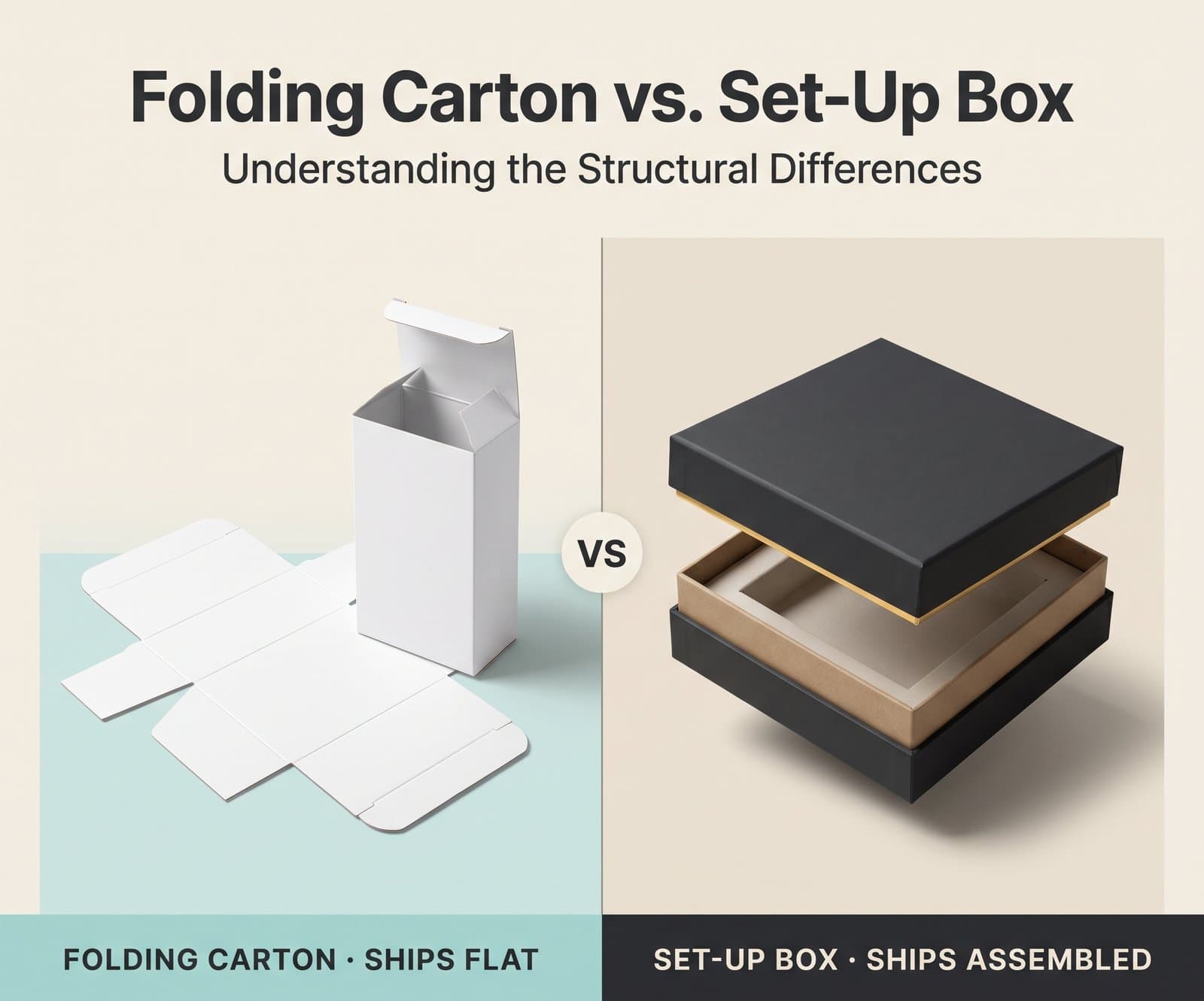
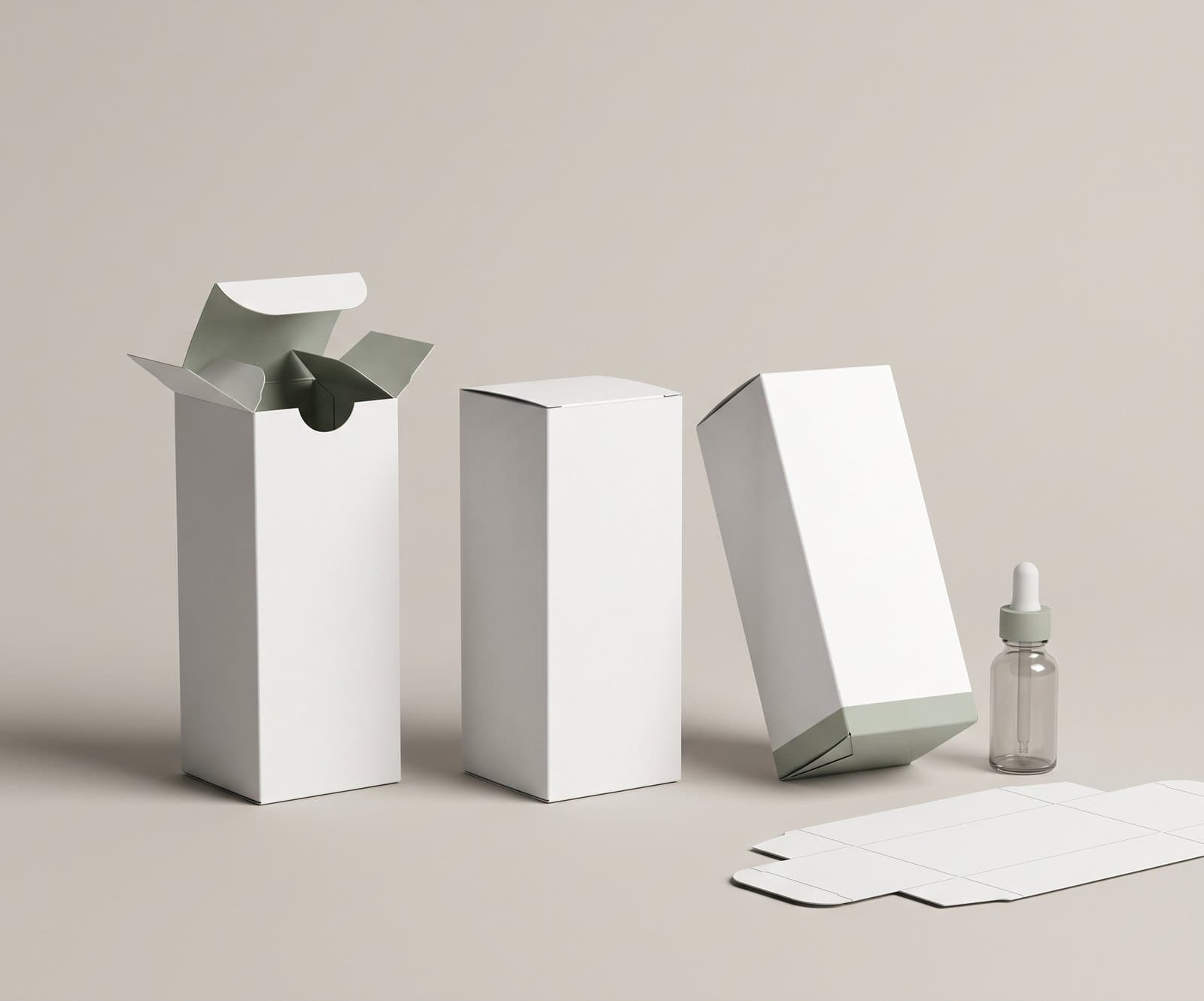
A tuck-end box is a folding carton made from a single die-cut sheet of paperboard, closed by tucking a curved flap into the box at one or both ends. No glue, tape, or inserts are needed to close it. There are two core styles. A Straight Tuck End (STE) has both closing flaps hinged from the same panel, giving a clean, uninterrupted front face. A Reverse Tuck End (RTE) has the top and bottom flaps hinged from opposite panels, which uses board more efficiently and usually costs less. A third variation, the Auto-Bottom (Crash Lock), pairs a tuck top with a pre-glued bottom for heavier products.
That's the short answer. The rest of this guide covers how each style works, which paperboard to specify, how to measure correctly, and which products belong in which box.
What Makes a Tuck-End Box Work?
Before comparing styles, it helps to know the anatomy. Every tuck-end carton shares the same core components:
- Main panels: Four body panels (front, back, and two sides) joined by a glued manufacturer's joint (also called the glue flap or side seam).
- Tuck flaps: The curved closing flaps that slide into the box opening. The curve makes insertion easy and prevents tearing.
- Dust flaps: The smaller side flaps that fold in first. They keep dust out, add rigidity at the ends, and give the tuck flap something to grip.
- Score lines: Pressed creases that tell the board exactly where to fold. Clean scoring is the difference between a crisp, square carton and one that bulges or cracks at the edges.
- Friction lock (slit lock): Small cuts at the shoulders of the tuck flap that catch against the dust flaps. This creates an audible "click" and keeps the box closed during handling and shelf display.
Because tuck-end boxes ship flat and pre-glued, they're fast to erect by hand and compatible with automated cartoning lines. That combination of low storage footprint, quick assembly, and full printable surface area is why they're the most common folding carton style in retail.
Tuck-End Box Styles Compared
Straight Tuck End (STE)
In a Straight Tuck End box, the top and bottom tuck flaps both hinge from the back panel and fold toward the front. The result is a front panel with no visible flap edges at either end.
Pros:
- Clean front face: Your artwork runs edge to edge without interruption, which is ideal for premium branding.
- Best for window cutouts: Because both closures sit toward the same side, the front panel can accommodate a larger display window.
- Consistent opening experience: Both ends open in the same direction, which feels intentional and polished.
- Cartoning-friendly: STE (sometimes called an "airplane" style) runs well on many automated cartoning machines.
Cons:
- Higher board usage: STE dielines don't nest as tightly on a press sheet, so there's more waste per unit.
- Slightly higher unit cost: The extra material typically translates to a modest price premium, especially at high volumes.
Best for: Cosmetics, skincare, fragrance, premium supplements, and any product where retail shelf appeal is a top priority.
Reverse Tuck End (RTE)
In a Reverse Tuck End box, the top tuck flap hinges from the back panel while the bottom tuck flap hinges from the front panel. The flaps close in opposite directions.
Pros:
- Efficient material use: RTE dielines nest tightly on the press sheet, reducing waste and cost per unit.
- Budget-friendly at scale: For large runs, the savings add up quickly.
- Industry standard: RTE is the workhorse of pharmaceutical, OTC, and general retail packaging.
Cons:
- Visible edge on the front: One flap edge sits at the bottom of the front panel, which slightly interrupts the design.
- Less ideal for large windows: The reversed flap reduces flexibility for front-panel die cuts.
Best for: Pharmaceuticals, OTC medications, vitamins, hardware components, software and electronics accessories, and high-volume retail SKUs.
Auto-Bottom (Crash Lock) Tuck-End
An Auto-Bottom, also called a Crash Lock bottom, combines a standard tuck top with a pre-glued bottom that locks into place automatically when the flattened carton is squared open.
Pros:
- Stronger base: Supports heavier products than a standard tuck bottom.
- Fastest manual assembly: Pop it open and the bottom forms itself, which is a big advantage for hand-packed fulfillment.
- Secure for glass and dense items: The bottom won't pop open under load.
Cons:
- Higher cost: Additional gluing points add to production cost.
- Less suited to very small cartons: The locking mechanism needs enough panel area to function well.
Best for: Candles, glass jars and bottles, food products, beverage accessories, and heavier cosmetics sets.
1-2-3 Bottom (Snap Lock) Tuck-End
A 1-2-3 bottom (or snap lock bottom) uses interlocking bottom flaps that are folded manually in sequence. It offers more strength than a standard tuck without the extra gluing of a crash lock.
Best for: Mid-weight products packed by hand in moderate quantities, where you want a sturdier base on a tighter budget.
Quick Comparison Table
FeatureSTERTEAuto-Bottom1-2-3 BottomFront panel appearanceCleanestOne visible edgeClean top, locked baseClean top, locked baseMaterial efficiencyModerateHighModerateModerateRelative costMediumLowestHighestMediumLoad capacityLightLightMedium to heavyMediumAssembly speedFastFastFastest (manual)SlowerTypical usePremium retailPharma, high volumeHeavier or fragile itemsMid-weight, hand-packed
Choosing the Right Paperboard
The style determines how a box closes. The board determines how it performs. Most tuck-end cartons are made from paperboard measured in points (pt), where 1 pt = 0.001 inches of thickness (caliper).
SBS (Solid Bleached Sulfate)
SBS paperboard is the premium standard for retail cartons. It's made from bleached virgin fiber, giving it a bright white surface that reproduces color, gradients, and fine type with excellent accuracy. It also takes specialty finishes such as foil stamping, embossing, and soft-touch lamination very well.
Other Common Boards
- CCNB / CUK (Clay-Coated News Back): A recycled board with a white coated print side and a gray back. It's more economical and eco-positioned, with slightly lower print brightness than SBS.
- Kraft paperboard: An unbleached brown board with a natural, earthy look. It's popular for organic, artisanal, and sustainability-focused brands.
Caliper Guidelines by Product Weight
These are practical starting points. Always confirm with a physical sample, because product shape, fragility, and shipping method all matter.
CaliperTypical UseExample Products14pt–16ptVery light itemsLip balm, sample sachets, playing cards, small labels18ptLight retail productsLipstick, serums in plastic tubes, USB drives, tea sachets20ptMedium-weight itemsGlass dropper bottles, supplement bottles, fragrance minis24ptHeavier or premium itemsFull-size fragrance, glass jars, multi-item kits, candles
Expert tip: Heavier board isn't automatically better. Going too thick on a small carton can cause tuck flaps to crack at the score lines or refuse to seat properly. Match the caliper to the carton size, not just the product weight.
How to Size a Tuck-End Box Correctly
Sizing mistakes are the most common and most expensive packaging error. Here's how to get it right the first time.
Understand L × W × D
Tuck-end dimensions are listed as Length × Width × Depth, and the order matters:
- Length (L): The longer side of the box opening.
- Width (W): The shorter side of the box opening.
- Depth (D): The distance between the two openings (the height of the box when standing on an end).
Swapping these values changes where the tuck flaps are located. A box specified as 2" × 1" × 6" opens at the small end (like a lipstick carton), while 6" × 1" × 2" opens along the long side.
Always Measure Internal Dimensions
Specify inside dimensions, the space your product actually occupies. Board thickness is added outward during dieline creation, so providing outside measurements will result in a box that's too tight.
Add the Right Clearance
- Snug fit (retail display): Add roughly 1/16" (1.5 mm) to each dimension so the product slides in without forcing.
- Easy fit (hand packing, irregular shapes): Add roughly 1/8" (3 mm).
- With an insert: Measure the insert, not the product, and then add clearance.
Practical Sizing Checklist
- Measure your product at its widest points, including caps, pumps, and closures.
- Decide which end the customer should open and orient L × W to that face.
- Add clearance based on fit and packing method.
- Consider whether an insert, leaflet, or secondary component needs space.
- Request a physical prototype or a printed flat dieline before approving production.
Real-World Applications: Which Style Fits Which Product?
Cosmetics and Skincare
Beauty brands compete on the shelf in seconds, so the STE is the usual default. It creates an uninterrupted front panel for bold branding, allows front-panel windows, and pairs well with 18pt–20pt SBS and premium finishes such as foil, spot UV, or soft-touch coating. Serum boxes, lipstick cartons, and eye cream boxes are classic examples.
Pharmaceuticals and OTC Products
RTE dominates here. Pharmaceutical packaging runs in very high volumes, so material efficiency matters. RTE cartons also work well with tamper-evident seals, printed lot codes and expiry dates, and Braille embossing where required by regional regulations. A leaflet (package insert) typically fits alongside blister packs or bottles.
Software, Electronics, and Accessories
Chargers, cables, USB drives, and software license cards typically use RTE in 16pt–18pt board for cost efficiency. Many brands add a hang tab (a die-cut extension with a hole) for peg display in retail aisles.
Supplements and Nutraceuticals
Supplement bottles usually need 20pt board. Brands choose STE for premium positioning or RTE for value lines. Depending on bottle weight, an Auto-Bottom may add extra security.
Candles, Glass, and Food Products
Weight and fragility make the Auto-Bottom with 20pt–24pt board the safer choice. For food that contacts the carton directly, confirm the board and coatings are food-safe for your market.
Playing Cards, Games, and Small Collectibles
The traditional card "tuck box" is essentially a small STE carton in 14pt–16pt board. It's lightweight, easy to open repeatedly, and fully printable.
Finishing Touches That Improve Shelf Appeal
A tuck-end box's flat panels make it an excellent canvas. Common enhancements include:
- Aqueous or UV coating: Protects print from scuffs and adds matte or gloss character.
- Soft-touch lamination: A velvety feel associated with luxury beauty and tech.
- Foil stamping and embossing: Draws the eye to logos and product names.
- Window cutouts with PET film: Lets shoppers see the product without opening the box, which works best with STE.
- Custom inserts: Paperboard inserts hold bottles or multi-piece kits in place.
- Inside printing: Adds a branded moment when the customer opens the box.
STE or RTE? A Quick Decision Guide
Choose Straight Tuck End if:
- Front-panel presentation is your top priority.
- You want a display window.
- You're positioning the product as premium.
Choose Reverse Tuck End if:
- You're producing high volumes and cost per unit matters.
- The product is functional or regulated (pharma, OTC, hardware).
- A small edge on the lower front panel won't affect your design.
Choose Auto-Bottom if:
- The product is heavy, glass, or fragile.
- You pack by hand and want faster assembly.
Frequently Asked Questions
What is the difference between a straight tuck and a reverse tuck box?
In a straight tuck box, both closing flaps hinge from the same (back) panel. In a reverse tuck box, the top and bottom flaps hinge from opposite panels. STE looks cleaner on the front, while RTE uses less material and costs less.
What thickness should a tuck-end box be?
Most tuck-end cartons use 16pt to 24pt paperboard. Light items like lip balm work at 14pt–16pt, while glass bottles and heavier products usually need 20pt–24pt.
Can tuck-end boxes hold heavy products?
Standard tuck-end boxes are designed for lightweight products. For heavier or fragile items, an Auto-Bottom (Crash Lock) or 1-2-3 bottom provides a much stronger base.
Are tuck-end boxes recyclable?
Paperboard tuck-end boxes are widely recyclable, especially uncoated SBS, CCNB, and kraft. Plastic lamination and window films can complicate recycling, so choose aqueous coatings and film-free designs if recyclability is a priority.
How do I measure a product for a tuck-end box?
Measure the product's internal requirements as Length × Width × Depth, where L and W describe the opening and D is the distance between openings. Add about 1/16" to 1/8" clearance depending on how snug you want the fit.
Conclusion
Tuck-end boxes remain the go-to folding carton for lightweight retail products because they're economical, fast to assemble, and highly printable. The key decisions come down to three things: style (STE for presentation, RTE for efficiency, Auto-Bottom for strength), board (SBS at 16pt–24pt for most retail uses), and accurate internal sizing with the right clearance.
If you've mapped out your product's dimensions and know which closure style fits your brand, the next step is seeing how those choices come together in a finished carton. You can explore tuck-end box styles, board options, and finishing features to compare configurations and bring your packaging specs to life.