Folding Carton vs. Set-Up Box: Key Structural Differences
Folding cartons ship flat; set-up boxes arrive rigid and assembled. Compare materials, strength, costs, and use cases to choose the right structure.
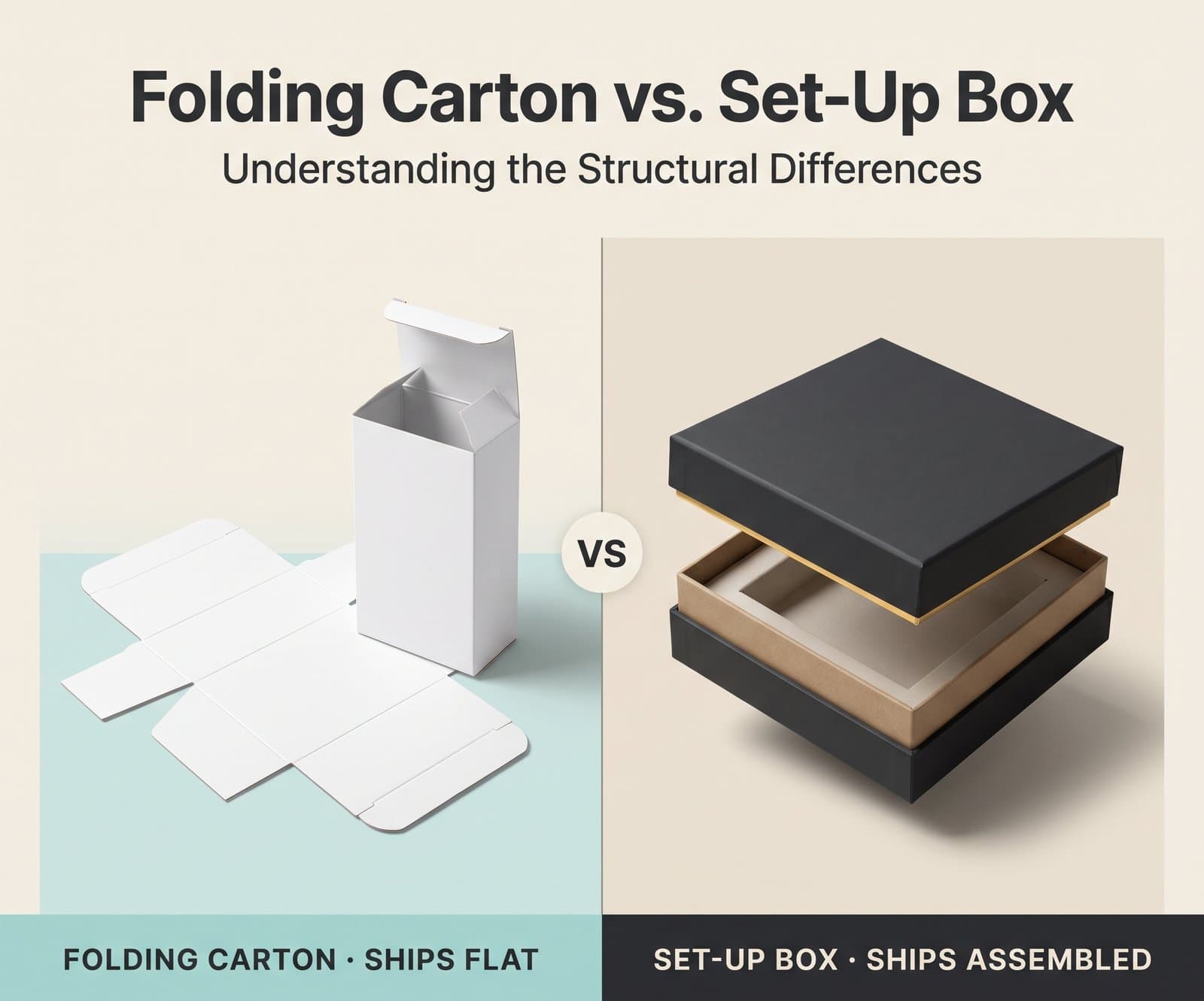
A folding carton is a lightweight paperboard box that is printed, die-cut, and glued as a flat blank, then shipped flat and folded into shape at the packing line. A set-up box (also called a rigid box) is built from thick, non-bending chipboard wrapped in printed paper, and it arrives fully assembled. The core structural difference is simple: folding cartons are collapsible, while set-up boxes are non-collapsible. That one distinction drives almost everything else, from material thickness and strength to freight cost, storage space, and the unboxing experience your customer has.
Below, we break down exactly how each structure is made, where each one performs best, and how to decide which fits your product, budget, and brand.
The Quick Answer: Side-by-Side Comparison
FactorFolding CartonSet-Up (Rigid) BoxStructureCollapsible; ships and stores flatNon-collapsible; ships and stores pre-assembledPrimary materialSBS, CUK/SUS, or recycled paperboard (CCNB)Rigid chipboard / greyboard wrapped in paper or specialty materialTypical thicknessRoughly 12–30 pt (about 0.3–0.75 mm)Roughly 1–3 mm board (about 40–120 pt)Printing methodPrinted directly on the boardPrinted on a separate wrap sheet, then wrapped around the boardAssemblyFolded and closed by the packer (manually or on automated lines)Arrives ready to use; product is simply placed insideShipping efficiencyHigh; many units per palletLow; you pay to ship and store airUnit costLow, especially at high volumesSignificantly higher per unitPerceived valueClean, functional, retail-readyPremium, luxurious, keepsake-worthyCommon usesCosmetics, food, pharmaceuticals, supplements, consumer goodsJewelry, watches, electronics, spirits, fragrance, luxury gifts, PR kits
What Is a Folding Carton?
A folding carton is the most common form of retail packaging in the world. Think of a cereal box, a toothpaste box, or the carton around a bottle of face serum. It begins life as a single sheet of paperboard and is converted into a flat, pre-glued blank that the packer "pops open" and closes.
Materials Used in Folding Cartons
The board grade you choose affects print quality, stiffness, food safety, and sustainability:
- SBS (Solid Bleached Sulfate): A premium virgin-fiber board with a bright white surface throughout. It is the go-to for cosmetics, pharmaceuticals, and anything needing sharp, vibrant print.
- CUK / SUS (Coated Unbleached Kraft): Stronger and more tear-resistant thanks to long, unbleached fibers. Often used for beverage carriers and heavier products.
- CCNB (Clay-Coated News Back) / recycled board: A recycled-content board with a white coated print surface and a grey reverse side. Budget-friendly and widely used for dry food and household goods.
Board thickness is measured by caliper, usually in points (pt), where 1 pt equals 0.001 inch. Most folding cartons fall between 12 pt and 30 pt, with 16–24 pt covering the majority of retail applications.
How Folding Cartons Are Made
- Printing: Usually offset lithography on large sheets, though digital printing is common for short runs.
- Coating or laminating: Aqueous coating, UV varnish, or film lamination for protection and finish.
- Die-cutting and creasing: A steel-rule cutting die cuts the outline and scores the fold lines in a single press stroke.
- Stripping: Waste board is removed from the cut sheet.
- Folding and gluing: A folder-gluer applies adhesive to the manufacturer's joint (glue flap) and folds the blank flat.
The finished cartons are stacked flat, strapped, and palletized.
Common Folding Carton Styles
- Reverse Tuck End (RTE) and Straight Tuck End (STE): Tuck flaps at top and bottom; the workhorse of retail packaging.
- Auto-lock (crash-lock) bottom: A pre-glued bottom that snaps into place when opened, ideal for heavier contents and fast packing.
- Sleeves: Open-ended wraps that slide over a tray or another carton.
- Tray and gable styles: Used for food, bakery, and display applications.
Strengths of Folding Cartons
- Lay-flat shipping and storage dramatically reduces freight and warehouse costs.
- Low unit cost, especially at higher volumes.
- Compatible with automated packing lines, which matters for high-throughput brands.
- Excellent print surface for detailed branding and regulatory information.
- Lightweight, which lowers downstream shipping costs to your customers.
Limitations of Folding Cartons
- Limited crush resistance; they typically need a corrugated shipper for transit protection.
- Can feel lightweight or "disposable" for high-ticket products.
- Heavier or fragile products may require inserts or thicker board grades.
What Is a Set-Up Box (Rigid Box)?
A set-up box earns its name because it is "set up" (fully constructed) at the factory and cannot be flattened. It is the premium tier of paperboard packaging: the type of box that holds a smartphone, a luxury watch, or a high-end fragrance.
Materials Used in Set-Up Boxes
- Rigid chipboard (greyboard): A dense, recycled-fiber board, typically 1 mm to 3 mm thick (often specified as 1.5 mm or 2 mm). Unlike folding carton board, it is not designed to bend.
- Wrap material: A printed paper sheet (commonly 120–157 gsm art paper) or a specialty material such as textured paper, linen, faux leather, or foil paper, glued over the board.
- Liners and inserts: Paper liners, foam, EVA, molded pulp, or board inserts that hold the product in place.
How Set-Up Boxes Are Made
- Board cutting: Chipboard is cut to size for the base and lid (or other components).
- Corner forming: Walls are formed either by V-grooving (cutting a V-shaped channel so the board folds at a crisp 90° angle) or by joining corners with stay tape (corner staying).
- Wrap printing and finishing: The wrap sheet is printed and finished separately, often with lamination, soft-touch coating, spot UV, foil stamping, or embossing.
- Wrapping: The wrap is glued and wrapped around the board, with the edges turned in over the rim for a clean interior finish. This is done by hand, semi-automatic, or fully automatic wrapping machines.
- Assembly and inserts: Magnets, ribbons, liners, and inserts are added before the finished boxes are packed.
Because the structure is permanent, the boxes are packed and shipped in their final three-dimensional form.
Common Set-Up Box Styles
- Two-piece (lid and base): The classic telescoping gift box, either full-telescope or partial.
- Shoulder/neck box: A three-piece construction with an inner collar that creates a refined, stepped reveal.
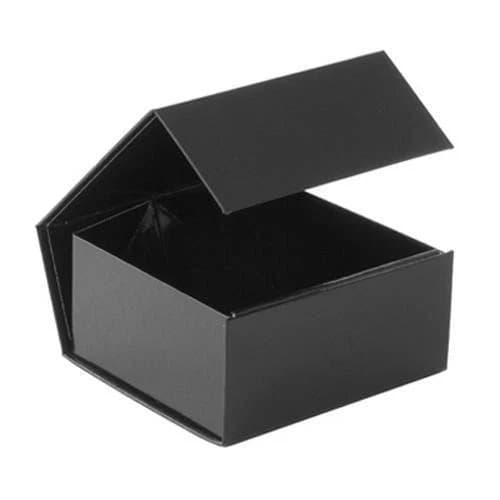
- Magnetic closure (book-style): A hinged lid secured by hidden magnets, popular for electronics and gift sets.
- Drawer (slide) box: A tray that slides out of an outer sleeve.
- Hinged lid box: A single-piece box with a permanently attached lid.
Strengths of Set-Up Boxes
- Superior structural integrity and crush resistance.
- High perceived value that can justify premium pricing.
- Reusable and keepsake-worthy, extending brand exposure well after purchase.
- Endless finishing options, from specialty wraps to precise, custom-fitted inserts.
Limitations of Set-Up Boxes
- Higher unit cost due to more material and labor-intensive construction.
- Expensive to ship and store because you are moving empty volume.
- Longer production lead times, particularly for handmade or complex styles.
- Generally not suited to high-speed automated filling lines.
The Structural Difference That Matters Most: Collapsible vs. Non-Collapsible
Nearly every practical trade-off between these two formats comes back to one question: does the box fold flat?
Material Thickness and Rigidity
A folding carton's board is thin enough to be creased and folded without cracking. A set-up box's chipboard is several times thicker and deliberately stiff. That is why the rigid box feels "solid" in the hand, and why it cannot be collapsed without damage.
Construction Method
- Folding cartons rely on die-cut score lines and a single glue joint. The strength comes from the board grade and the style (for example, an auto-lock bottom).
- Set-up boxes rely on V-grooved or stayed corners plus a laminated wrap that locks the structure together. The wrap is both decoration and structure.
Where Printing Happens
On a folding carton, the artwork is printed directly on the board. On a set-up box, the artwork is printed on a separate wrap sheet. This is why rigid boxes can use exotic materials (fabric, textured stock, metallic papers) that would be impossible to print and fold as a carton.
Cost Implications: Shipping Flat vs. Shipping Air
Unit price is only part of the story. Total landed cost includes freight, warehousing, and handling, and this is where the structural difference hits hardest.
A Rough Illustration
Imagine a product box measuring roughly 8 × 6 × 3 inches:
- As a set-up box, each unit occupies its full volume (about 144 cubic inches) in a shipping carton and on a pallet. A standard pallet might hold only several hundred to around a thousand of them, depending on stacking and case packing.
- As a folding carton, that same box ships as a flat blank a fraction of an inch thick. The same pallet can often hold many thousands of units.
The exact figures vary by size and packing configuration, but the pattern is consistent: rigid boxes can require many times more freight space and warehouse space per unit. For brands importing packaging from overseas, or storing a few months of inventory, that difference can rival or exceed the difference in unit price.
Tooling and Setup Costs
- Folding cartons need a cutting die and printing plates (for offset). These are relatively affordable and reusable for reorders.
- Set-up boxes may need cutting tools for board and wrap, plus custom insert tooling. Handwork and specialty finishes add further cost.
Labor at Your End
Folding cartons must be erected and closed during packing, which adds labor unless you use automated equipment. Set-up boxes arrive ready, so packing is often faster per unit, a small but real offset to their higher cost.
Expert tip: If you love the rigid look but your freight bills are painful, ask about collapsible (foldable) rigid boxes. These hybrid designs use rigid chipboard panels with hinged construction and fold flat for shipping, then snap into shape with magnets or tabs. They cost more than a standard folding carton but can dramatically reduce shipping volume compared with a traditional set-up box.
Real-World Scenarios: Which Structure Fits?
Scenario 1: A Skincare Brand Launching in Retail
A brand selling a 30 ml serum to pharmacies and beauty chains needs thousands of units, consistent shelf presence, and room for ingredient and regulatory copy. A folding carton in SBS board with a soft-touch coating and foil accent delivers a polished look at a sustainable unit cost.
Scenario 2: A Watch or Jewelry Brand
A product retailing at several hundred dollars needs packaging that matches its price point and protects it through gifting. A two-piece or magnetic set-up box with a fitted insert signals quality from the first touch and is likely to be kept by the customer.
Scenario 3: A Direct-to-Consumer Subscription Box
Monthly shipments mean high volume and ongoing freight costs. A folding carton or corrugated mailer usually makes more sense, reserving rigid boxes for special editions, anniversary kits, or VIP tiers.
Scenario 4: A Tech Accessory Brand
Earbuds or a premium charger often use a rigid box for the flagship product line, while accessories and replacement parts use folding cartons. A tiered approach keeps overall packaging costs balanced without diluting the brand at the top end.
Scenario 5: Corporate Gifting and PR Kits
For influencer kits and client gifts, where the unboxing moment is the marketing, the extra cost of a set-up box is typically easy to justify.
How to Choose: A Practical Decision Checklist
Ask yourself these questions before committing to a structure:
- What is the product's retail price? Higher-priced goods generally benefit from rigid packaging; everyday goods rarely need it.
- What volume do you need? High volumes favor folding cartons for cost and automation.
- Where will the box be sold? Retail shelves reward print-rich cartons; DTC and gifting reward unboxing experiences.
- How heavy or fragile is the product? Heavier items may need a rigid box, or a heavier-caliper carton with an insert.
- What are your freight and storage constraints? Limited warehouse space strongly favors lay-flat packaging.
- Will customers keep the box? If yes, a set-up box extends your brand's life in the home.
- What are your sustainability goals? Both formats can be recyclable, but finishes such as film lamination, magnets, and foam inserts can complicate recycling. Choose paper-based inserts and recyclable coatings when possible.
Conclusion: Structure Follows Strategy
The difference between a folding carton and a set-up box comes down to collapsible versus non-collapsible construction. Folding cartons are thin, printed paperboard blanks that ship flat, keep costs low, and scale easily. Set-up boxes are thick, wrapped chipboard structures that arrive assembled and deliver a premium, lasting impression, at a higher cost for materials, labor, and freight.
Neither is "better." The right choice depends on your product's price point, volume, distribution channel, and the experience you want customers to have.
If your priorities are efficiency, retail readiness, and scalability, you can explore folding carton styles and board options to see which construction suits your product. If you are aiming for a premium presentation that customers keep, take a closer look at how set-up and rigid box constructions are finished and configured as a next step in planning your packaging.